
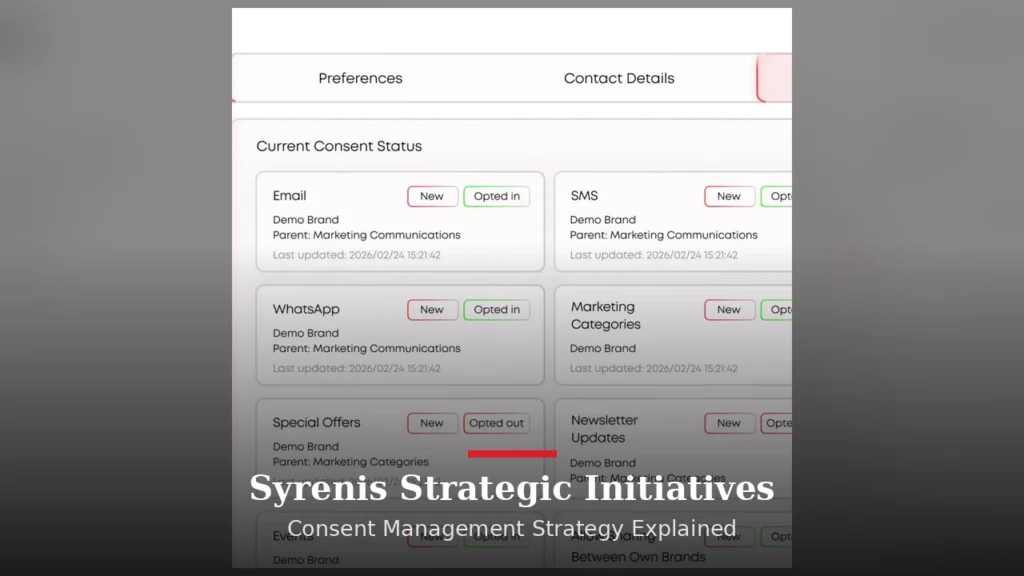
Syrenis Strategic Initiatives: How the Consent Management Specialist Is Planning Its Next Growth Era
Introduction
In an economy where data is one of the most valuable — and most regulated — assets a company can hold, the businesses that help other businesses manage consumer consent sit at the centre of a quiet but powerful market. Syrenis, a consent and preference management specialist based in the North of England, is one of the firms that has been operating in this space far longer than most. As it celebrated its 25th anniversary in 2025, the company laid out a series of syrenis strategic initiatives that signal where it intends to go next.
The moves announced across 2025 paint a coherent picture: a refreshed leadership team, an ambitious revenue goal, a planned new Northern headquarters, two major consulting partnerships, and continued investment in the Cassie platform that underpins the business. Together, the syrenis strategic initiatives suggest a company deliberately repositioning itself for a larger share of the global privacy technology market. For business leaders, investors, and compliance professionals, the strategy is worth understanding because it reflects broader currents shaping the data privacy industry itself.
This article breaks down each of the major initiatives, explains what the Cassie platform actually does, and analyses what Syrenis’s roadmap means for the future of consent and preference management. Every fact below is drawn from verified public sources, and where details remain unconfirmed, that is stated plainly.
syrenis strategic initiatives: Who Syrenis Is After 25 Years in Consent Management
Syrenis describes itself as a consent and preference management specialist, a positioning it has earned through more than two decades of focused work. Founded in 2000, the company began building expertise in data governance long before privacy regulations made the subject a boardroom priority. By the time it marked its 25th anniversary in 2025, Syrenis could fairly describe itself as a pioneer in the space, with over twenty years of experience behind it.
The anniversary itself was the launchpad. Syrenis marked the milestone with a PRNewswire announcement laying out a slate of strategic appointments, and regional press such as Prolific North covered the arrival of a new chief executive as the headline move. In other words, the syrenis strategic initiatives were presented from day one as a deliberate reset — not a routine reshuffle, but a public statement that the next era of the company would be run at a different pace.
The company is based at Sci-Tech Daresbury in the North of England, a technology campus that reflects its roots outside the traditional London-centred tech corridor. That northern identity matters to the company’s story, because it connects directly to one of its current strategic initiatives — the plan for a new Northern headquarters tied to broader UK efforts to spread technology investment beyond London, Cambridge, and Oxford. The company employs between 51 and 200 people, putting it in the established mid-size SaaS bracket: large enough to serve global enterprises, nimble enough to evolve its product quickly.
Syrenis is trusted by governments, healthcare providers, and multinational brands across the pharmaceutical, financial, and automotive sectors. Its clients include FTSE 100 and Fortune 500 names, among them one of the top five US hospitals for cancer care and a Fortune 500 pharmaceutical company. The firm deliberately names sectors rather than individual clients, which is standard practice for a company whose clients guard their data partnerships closely. What it discloses instead is scale: the Cassie platform powers consent and preference management for brands overseeing more than 1.2 billion customer records.
The company’s growth has not gone unnoticed by investors. In February 2019, Syrenis attracted investment from Sir Terry Leahy, the former Tesco CEO, and Bill Currie of the William Currie Group, both of whom joined the board. That backing was explicitly aimed at accelerating the brand, particularly in North America, and it set the stage for the transatlantic partnerships that would follow six years later.
syrenis strategic initiatives: What the Cassie Platform Actually Does
Cassie, launched in 2018, is Syrenis’s flagship SaaS platform and the commercial engine behind its strategy. In practical terms, it gives organisations a central system for managing how customers grant, change, and withdraw consent for the use of their personal data — and for managing the communication preferences attached to that data. As privacy regulations have multiplied across jurisdictions, that capability has shifted from a compliance checkbox to a genuine operational requirement.
The platform’s feature set is broad. It maintains detailed consent audit trails, so companies can demonstrate exactly when and how each customer gave permission. It includes a central consent language repository, which keeps the wording of notices and requests consistent across every channel and market. Self-service preference centres let customers control their own communication choices directly, reducing support burden while improving the customer experience. A data harmonization engine consolidates consent records from legacy systems and modern CRMs alike into a real-time single source of truth.
For compliance teams, Cassie provides RoPA (record of processing activities) and data mapping tools, along with compliance management and reporting designed for multi-lingual, multi-jurisdiction operations. The platform supports GDPR, CCPA, and HIPAA requirements and holds SOC 2 accreditation, which matters to the enterprise buyers it targets. On the integration side, it offers more than 350 API integrations, a depth that Gartner’s Consent and Preference Management Market Guide specifically called out. Gartner noted that Cassie has “developed a deep and rich feature set across all four service categories especially where integration is concerned, equally handling data from legacy systems through data loader functions and complex CRM APIs.” Syrenis is recognised by Gartner as a market leader in consent management.
The first-party data launch was aimed squarely at marketers. Announced via PRNewswire, the new Cassie features were framed as a way to empower marketers and improve the consumer experience by making consented data usable for personalisation — turning the consent database from a compliance archive into a working marketing asset. It is a concrete example of how the syrenis strategic initiatives link product development to the company’s “privacy as strategic advantage” message.
The Cross-Domain Consent solution was billed as pioneering when Cassie unveiled it. By allowing cookie consent to be shared across a brand’s domains, it tackles consent fatigue head-on: customers stop being asked the same permission questions on every site a company owns, while the underlying records stay accurate and auditable. For large brands running dozens of digital properties, that is both a better customer experience and cleaner compliance.
Breaking Down the syrenis strategic initiatives
Initiative 1: A Rebuilt C-Suite for the Next Growth Phase
The most visible of the syrenis strategic initiatives is the overhaul of the company’s senior leadership, announced alongside the 25th anniversary. The centrepiece is the appointment of Adam Binks as Chief Executive Officer, replacing Glenn Jackson, who stepped down after six years and retired. Binks arrived with a notable track record: he had spent five years as CEO of SysGroup plc, during which he became the youngest CEO on the AIM market. Under his leadership, SysGroup executed multiple strategic acquisitions, delivered year-on-year EBITDA growth, and roughly trebled in size.
The appointment was announced as part of the 25th-anniversary communications and picked up by the regional business press, with Prolific North covering the former youngest AIM CEO’s move to the Daresbury SaaS specialist. The framing mattered: Syrenis was not quietly replacing a retiring chief executive but publicly installing a growth operator. That announcement set the tone for everything else in the syrenis strategic initiatives — leadership first, then the targets that leadership would be accountable for.
He is joined by two strategic appointments. Martin Audcent came in as Chief Financial Officer, bringing financial strategy and compliance credentials from his time as CFO of AIM-listed SysGroup plc and, before that, Associate Finance Director at NCC Group plc. His background in listed-company finance is directly relevant to the company’s stated growth goals. Paul Glynn took the role of Chief Strategy Officer (CSO), joining from Nasdaq-listed Digimarc, where he will lead sales strategy. The combination — a growth-focused CEO, a listed-markets CFO, and a sales-strategy CSO from a Nasdaq company — reads as a leadership team assembled specifically for scale.
The appointments were framed as a deliberate break with the past. Where the previous era built the company’s foundations and its flagship platform, the new team was brought in to accelerate. For a company setting ambitious targets, putting experienced, proven operators at the top is the most concrete signal that the strategy is meant to be executed, not just announced.
Initiative 2: Doubling Revenue and a New Northern Headquarters
The headline ambition in the company’s strategy is its revenue target: to more than double revenue within five years. It is important to be precise here — this is an ambitious target, not an achievement already booked. It is the kind of goal that requires every other initiative to work: leadership, partnerships, and product all have to pull in the same direction.
Binks framed the target in terms of the company’s philosophy toward data privacy. “At Syrenis, data privacy is more than a regulatory mandate – it’s the engine driving our next wave of innovation, beyond compliance,” he said. “Our purpose is to empower Fortune 500 companies to transform data protection into a strategic advantage.” That positioning — privacy as competitive advantage rather than regulatory burden — is the thread that connects the commercial target to the product strategy. If enterprise clients genuinely believe that better consent management wins customer trust, then a platform like Cassie becomes a growth investment rather than a cost centre.
The target was the centrepiece of the anniversary announcement carried by PRNewswire: more than double revenue within five years, with data privacy positioned as the engine of the next wave of innovation. The company’s stated purpose — to empower Fortune 500 companies to transform data protection into a strategic advantage — ties the commercial goal directly to the product story. Among the syrenis strategic initiatives, this is the one every other move will ultimately be judged against.
Running alongside the revenue target is a plan for a new Northern headquarters. The move is presented as part of wider UK government initiatives to spread technology innovation beyond London, Cambridge, and Oxford, keeping Syrenis’s roots in the North while giving it a base built for expansion. One report identified the destination as Warrington, though the company’s own announcements speak of a new Northern HQ without confirming a specific address. Given that Daresbury sits in Cheshire near Warrington, the move may amount to a relocation within the region — but until Syrenis confirms details, the location should be treated as reported rather than settled.
Together, the revenue goal and the headquarters plan tell a story of a company investing ahead of growth. Expanding physical capacity while publicly committing to an aggressive growth trajectory is a deliberate, high-visibility statement of intent.
Initiative 3: The Data Privacy Group Alliance
On August 6, 2025, Syrenis announced a strategic alliance with The Data Privacy Group (DPG), unveiled from Daresbury. The partnership combines Syrenis’s Cassie technology with DPG’s privacy programme consultancy and implementation expertise, creating end-to-end solutions that span multiple jurisdictions. In practice, this means clients can buy the technology and the expert deployment help as a single proposition — a meaningful advantage in a market where buying software is only half the challenge and implementing it across legal entities and regions is the other half.
The alliance was announced from Daresbury with a PRNewswire headline declaring the two firms would forge a strategic alliance to redefine global privacy standards. The emphasis on standards is deliberate: by pairing Cassie’s technology with DPG’s consultancy and implementation expertise, the partners are selling end-to-end solutions across multiple jurisdictions rather than software licences alone. It is the delivery model the syrenis strategic initiatives need if the platform is to reach enterprise buyers at scale.
The announcement carried strong statements of intent from both sides. Binks said: “This partnership sets a new benchmark for privacy solutions… our clients will not only meet compliance requirements but will lead the way in building customer trust and loyalty.” DPG’s CEO, Iain Borner, added: “Syrenis’ innovative technology is a game-changer for operationalising privacy and enabling businesses to align compliance with customer-centricity.”
The logic of the alliance is straightforward. Consultancies bring client relationships, regulatory knowledge, and implementation capacity; technology vendors bring scalable product. By binding the two together, Syrenis gains a delivery channel for Cassie that does not require it to build a large in-house services arm, while DPG gains a proven platform to anchor its privacy programmes. For enterprise buyers operating across multiple jurisdictions — exactly the Fortune 500 audience Binks described — that packaged offering is easier to adopt than a standalone software purchase.
Initiative 4: The Myna Partnership and the US Expansion Play
Two weeks before the DPG announcement, on July 22, 2025, Syrenis unveiled a second consulting partnership — this one aimed squarely at the United States. Myna, a US-based privacy consultancy headquartered in Fort Lauderdale, Florida, was appointed as Syrenis’s official consulting and implementation partner. The arrangement combines Cassie’s technology with Myna’s expertise in privacy strategy, programme design, and enterprise rollout, and it is notable that Myna’s consultants have delivered privacy transformation programmes for Fortune 100 companies.
The partnership was announced on July 22, 2025, via PRWeb, with releases issued jointly from Daresbury and Fort Lauderdale, Florida — Myna’s home base. The headline promise was to power the future of global privacy operations, combining Cassie’s technology with Myna’s privacy strategy, programme design, and enterprise rollout expertise. With Myna’s consultants having delivered privacy transformation programmes for Fortune 100 companies, the alliance gives the syrenis strategic initiatives a credible US delivery arm without the cost of building one from scratch.
The announcement, issued from Daresbury and Fort Lauderdale jointly, underscored the ambition. “We don’t do half-measures at Syrenis and neither does Myna. This partnership is about speed, scale and strategy,” Binks said. “This alliance means our clients won’t just be compliant. They will be confident.” Myna’s Managing Partner, Eric Deiterich, also publicly endorsed the platform, lending the partnership credibility on the consulting side.
The strategic significance is hard to miss. Back in 2019, the investment from Leahy and Currie was explicitly aimed at accelerating the brand in North America. The Myna partnership is the operational expression of that intent: a US-based implementation partner with Fortune 100 credentials gives Syrenis a credible route into the American enterprise market without having to build a full stateside professional services organisation from scratch. Combined with the DPG alliance covering broader multi-jurisdiction delivery, the two partnerships give the company consulting coverage on both sides of the Atlantic — a sensible foundation for a revenue-doubling plan.
Initiative 5: Product Innovation and Market Recognition
The fifth initiative is the one that underpins everything else: continued investment in the Cassie platform itself. A services-led growth strategy only works if the product keeps winning on its merits, and Syrenis has been developing Cassie in directions that track the market’s biggest shifts.
Underpinning the roadmap is a platform Gartner described as “fully customizable,” with a deep feature set across all four consent-and-preference service categories. That depth — from consent audit trails to a central consent language repository, self-service preference centres, and a data harmonization engine feeding a real-time single source of truth — is what lets Syrenis pitch Cassie as infrastructure rather than a point solution. Within the syrenis strategic initiatives, product innovation is the quiet engine: less headline-grabbing than a new CEO, but the part customers actually buy.
The first-party data features launched for marketers address one of the industry’s defining transitions. As third-party cookies fade and privacy rules tighten, brands are being forced to build direct, consented relationships with their customers. Features that help marketers use first-party data effectively — within the boundaries of what customers have agreed to — turn compliance infrastructure into a marketing asset. That is precisely the “privacy as strategic advantage” argument Binks has been making.
The Cross-Domain Consent solution tackles a related friction. Large brands typically operate multiple websites and digital properties, and without shared consent, customers face the same permission requests on every domain — a phenomenon known as consent fatigue. By allowing cookie consent to travel across a brand’s domains, Cassie reduces that friction, improving the digital experience while keeping the underlying consent records accurate and auditable.
External validation has followed. Syrenis is recognised by Gartner as a market leader in consent management, and the Gartner Consent and Preference Management Market Guide praised the platform’s integration depth across legacy systems and complex CRM APIs. In a crowded category where buyers struggle to distinguish vendors, that kind of analyst recognition carries real commercial weight — it shortens enterprise sales cycles and opens doors that marketing alone cannot.
What the syrenis strategic initiatives Mean for the Privacy Industry
Stepping back, the syrenis strategic initiatives read as a case study in how a maturing privacy technology company plans to scale. The pattern is instructive for the industry at large. First, the leadership rebuild shows that privacy tech has entered a phase where growth operators, not just founders and engineers, run the show. When a company appoints a CEO known for acquisitions and EBITDA growth, it is signalling that the market is ready for consolidation and commercial expansion.
Second, the dual consulting partnerships reflect a structural truth about privacy software: the technology is necessary but not sufficient. Enterprises need implementation, change management, and ongoing programme support, and vendors that bundle credible services with their platforms will win against those that sell licences alone. The SaaS business model only works at enterprise scale when someone owns the messy middle of deployment — similar to how other business software categories pair platforms with implementation expertise, a dynamic explored in coverage of enterprise SaaS pricing and packaging models.
The syrenis strategic initiatives also arrive at a moment of consolidation. Larger platform vendors are building consent capabilities into broader suites, which squeezes standalone specialists — unless those specialists can prove deeper expertise and better integration. Syrenis’s answer is visible in the strategy: analyst recognition, more than 350 integrations, and consulting partnerships that make Cassie easier to adopt than a rival’s checkbox feature.
Third, the product direction — first-party data, cross-domain consent, real-time single sources of truth — maps exactly onto where regulation and consumer expectations are pushing the market. Companies that once treated consent as a legal formality now treat it as the foundation of their customer data strategy. Vendors that help them make that shift, rather than merely ticking compliance boxes, are positioned to capture the larger budgets that follow.
Regulation and consumer behaviour are pushing the same way. Third-party cookies are disappearing, privacy rules keep tightening across jurisdictions, and customers are quicker to punish brands that misuse their data. In that environment, the syrenis strategic initiatives bet that consent infrastructure graduates from legal cost centre to commercial asset — the foundation of first-party data strategies and trusted customer relationships.
Finally, the revenue-doubling target and the Northern HQ plan underline a geographic point: the UK’s privacy technology sector is not confined to London. With government backing for regional tech clusters and a deep talent pool in the North of England, companies like Syrenis can build global businesses from regional bases. If the strategy succeeds, it will be evidence that ambitious scale-ups do not need a capital-city postcode.
syrenis strategic initiatives: Frequently Asked Questions
What are the syrenis strategic initiatives?
The syrenis strategic initiatives are the growth moves the company set out around its 25th anniversary in 2025: a rebuilt C-suite led by CEO Adam Binks, CFO Martin Audcent, and CSO Paul Glynn; an ambitious target to more than double revenue in five years; a planned new Northern headquarters; a strategic alliance with The Data Privacy Group announced in August 2025; a US consulting partnership with Myna announced in July 2025; and continued product innovation on the Cassie platform, including first-party data features and Cross-Domain Consent.
Who is the CEO of Syrenis?
Adam Binks is the Chief Executive Officer of Syrenis. He was previously CEO of SysGroup plc for five years, where he became the youngest CEO on the AIM market, led multiple strategic acquisitions, delivered year-on-year EBITDA growth, and roughly trebled the size of the company. He succeeded Glenn Jackson, who stepped down after six years and retired.
What is the Cassie platform?
Cassie is Syrenis’s flagship SaaS platform for consent and preference management, launched in 2018. It gives organisations a central system for managing customer consent and communication preferences, with features including consent audit trails, a central consent language repository, self-service preference centres, a data harmonization engine, RoPA and data mapping tools, compliance reporting across jurisdictions (GDPR, CCPA, HIPAA), SOC 2 accreditation, and more than 350 API integrations.
What is Syrenis’s revenue target?
Syrenis has set an ambitious target to more than double its revenue within five years. This is a stated goal, not an achievement already reached. CEO Adam Binks has framed it around the idea that data privacy is “more than a regulatory mandate” and should be treated as an engine of innovation and competitive advantage for the company’s enterprise clients.
Who are Syrenis’s strategic partners?
In 2025 Syrenis announced two major partnerships: a strategic alliance with The Data Privacy Group (August 6, 2025), combining Cassie technology with DPG’s privacy programme consultancy and implementation expertise for end-to-end multi-jurisdiction solutions; and a partnership with US-based privacy consultancy Myna (July 22, 2025), appointed as Syrenis’s official consulting and implementation partner to support expansion in the American market.
Is Syrenis recognised by industry analysts?
Yes. Syrenis is recognised by Gartner as a market leader in consent management. Gartner’s Consent and Preference Management Market Guide praised Cassie for its deep and rich feature set across all service categories, particularly integration — noting its ability to handle data from legacy systems through data loader functions as well as complex CRM APIs.
Conclusion
Strategies are judged by execution, and Syrenis’s roadmap sets a demanding bar. Doubling revenue in five years requires the new leadership team to convert partnerships into pipeline, pipeline into deployments, and deployments into renewals and expansion. The DPG and Myna alliances need to produce joint wins, not just joint press releases. The Northern HQ move needs to support hiring at the pace the target implies. And Cassie needs to keep innovating faster than a competitive field that includes well-funded rivals.
Watch the milestones, not just the headlines. The syrenis strategic initiatives will show their first real results when the DPG and Myna alliances convert into joint enterprise wins, when the new Northern headquarters starts supporting faster hiring, and when Cassie’s roadmap delivers features competitors cannot match. The five-year revenue target is public, which means every future announcement will be measured against it — a discipline that focuses execution, but leaves no room to hide.
The early signs are structured in the company’s favour. The leadership team has done this kind of scaling before. The partnerships cover both sides of the Atlantic with credible, named firms and public executive backing. The product has analyst recognition and a feature set that maps to real market demand. And the 2019 investment from figures like Sir Terry Leahy suggests the company has long had believers with serious commercial judgement.
There are, of course, risks that any honest analysis must acknowledge. The privacy technology market is competitive and consolidating, and larger platform vendors are building consent capabilities into broader suites. Economic downturns can delay enterprise software purchases, however strategic. And ambitious revenue targets, publicly stated, become the yardstick against which every future announcement is measured. None of that diminishes the coherence of the plan — but it does mean the next few years will be a genuine test.
For now, what can be said with confidence is that Syrenis has laid out one of the clearest growth strategies in its sector: new leadership with a scaling track record, an explicit revenue ambition, transatlantic delivery partnerships, regional investment, and a product roadmap aimed at the future of first-party data. Whether it doubles its revenue or not, the attempt will be worth watching — because the way it plays out will tell us a great deal about where the consent and preference management market is heading.
That kind of long-horizon commercial ambition is also a reminder of how disciplined growth plans get built in any sector — the same principles behind building sustainable new revenue streams apply whether the product is software or anything else. And in the world of technology investing, where backing the right operators matters as much as backing the right product, Syrenis’s bet on proven leadership echoes the playbook of investors and executives who specialise in scaling ambitious tech businesses.
Pingback: Matt Danzeisen: The Quiet Financier Behind Thiel Capital and Crescendo Equity Partners - Nexbuzz