
Grammarvista.com: An Honest Guide to the Grammar Vista Website
Introduction
If you have ever searched the web for a quick answer to a grammar question, you may have come across grammarvista.com in the results. At first glance, the name suggests a grammar-checking tool, but that assumption is not quite right. Grammarvista.com is actually a content website — an online blog focused on English grammar and vocabulary — and understanding what it really is will save you from confusing it with a similarly named tool.
This guide walks you through everything the site actually offers, based on what is published on its own pages. We will look at its grammar guides, its vocabulary resources, its content categories, and the important difference between grammarvista.com and a different site called Grammervista.com. We will also cover a few honest caveats, because not everything on the site is what it seems, and you deserve to know that before you rely on it.
What Is Grammarvista.com?
Grammarvista.com is an online resource dedicated to English grammar and vocabulary, presented in the format of a blog rather than an interactive application. Its official About page describes it as “your ultimate destination for mastering English grammar and vocabulary,” and it positions itself as a learning destination for students, professionals, and language enthusiasts. The site publishes written articles that explain grammar rules, clarify confusing word choices, and build vocabulary.
It is important to understand what kind of website this is. Grammarvista.com belongs to a growing category of information platforms that publish explainer-style articles on specific topics — similar in spirit to other online information platform sites such as Domikyo, which we have also covered on this site. It does not provide software, an account dashboard, or any tool you log into; you simply visit, read an article, and leave with an answer.
The domain itself is relatively young. WHOIS records show that grammarvista.com was registered on August 30, 2024 through NameCheap, and it sits behind Cloudflare hosting in the United States. A domain registration date is not the same as a launch date, so the site may have gone live later, but the record tells us this is a roughly two-year-old property as of this writing. That context matters when you evaluate how established its content library is compared to older, larger grammar resources.
The site also has a clear, if minimal, legal footprint. Its Disclaimer page states that content on grammarvista.com is governed by New York State law, with disputes to be handled in New York County, New York — a small but concrete detail that anchors the site to a US jurisdiction. Its Terms of Service set a 13+ age eligibility for users, and its Privacy Policy discloses that grammarvista.com collects data through newsletter signups, contact forms, and surveys, alongside technical data such as IP addresses, browser types, and referrers gathered via Google Analytics and advertising cookies. None of this is unusual for a free content site, but it is worth knowing exactly what you hand over when you interact with grammarvista.com beyond simply reading its articles.
The site’s own materials describe it as being “powered by a passionate team of language experts, writers, and educators.” That sounds reassuring, but here is the honest part: no individual names are published anywhere on the site. The About page, the Contact page, the Privacy Policy, and the Disclaimer all name nobody. There is no editor profile, no author bylines tied to real credentials, and no company registration details. Who actually owns and runs grammarvista.com is simply not disclosed to visitors.
What Does Grammarvista.com Offer?
According to the site’s own About page, its content falls into four pillars. These are the categories the site claims as its core offering, so they are the most reliable description of its purpose.
Comprehensive Grammar Guides
The first pillar covers grammar guides from basic to advanced levels, with explanations, examples, and practical tips. In practice, this means articles that tackle common points of confusion — the kind of questions people type into search engines every day. Real examples currently live on the site include posts such as “friends, friend’s or friends’,” “draw, drew or drawn,” “today’s or todays,” and “months, month’s or months’.” These are classic apostrophe and verb-form questions, and they form the backbone of the site’s grammar coverage.
Each of these guides lives at its own dedicated URL on grammarvista.com, so readers usually arrive at a single focused page rather than a long index. The guides follow a consistent explainer format: state the rule, show examples, and clear up the common mistake. That structure makes grammarvista.com easy to skim when you need a fast answer to one specific question, which is exactly how most visitors use the site.
Vocabulary Enhancement
The second pillar is vocabulary building. The About page mentions a word-of-the-day feature, thematic vocabulary lists, synonyms and antonyms, and context-specific usage guidance. This is aimed at readers who want to expand their word power, whether for exams, professional writing, or general fluency. A strong vocabulary section can be genuinely useful for English learners, though the depth and consistency of these lists can only be judged by browsing the articles individually.
For regular visitors, the vocabulary side of grammarvista.com is meant to turn occasional lookups into a daily learning habit — a small dose of new words each day rather than cramming before an exam. Thematic lists group words by topic or situation, while the synonyms and antonyms coverage helps writers find the precise term instead of repeating the same safe choice. As with the grammar guides, the material is free to read with no account required.
Grammar and Vocabulary Corrections
The third pillar promises correction tips and error analysis — articles that identify common mistakes and explain how to fix them. The About page specifically mentions tenses, subject-verb agreement, and confusing words as focus areas. This is the instructional heart of the site: rather than pasting your text into a checker, you read an explanation of a mistake you tend to make and learn the rule behind it. For students and non-native speakers, this learn-the-rule approach can actually be more durable than automated correction.
What makes this pillar distinct on grammarvista.com is that it teaches patterns rather than fixing sentences. An automated tool corrects your text and moves on; a correction-tips article explains why “draw, drew, drawn” trips people up, so you stop making the error in the first place. Readers who prefer understanding over autocorrect will get the most from this part of the site.
Engaging Content
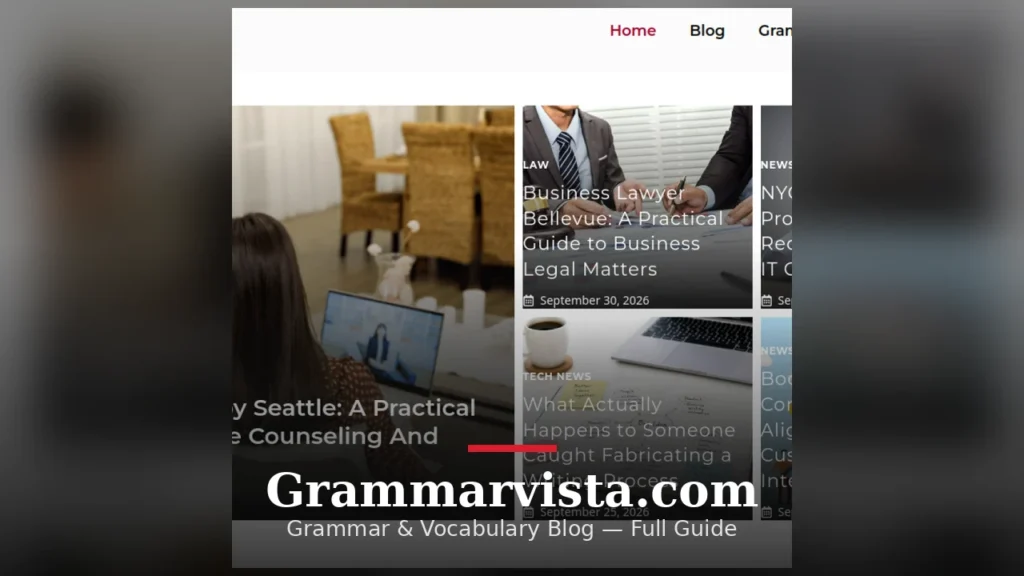
The fourth pillar is described as regularly updated blog content with practical advice, facts, and interactive exercises. This is where the site broadens beyond pure grammar instruction. A visit to the live homepage of grammarvista.com shows that the blog section now carries general-interest posts alongside the grammar core — articles filed under Health, Law, News, and Tech News. Real examples spotted on the live site include “Virtual Therapy Seattle” (Health), “Business Lawyer Bellevue” (Law), “NYC IT Support” (News), and “What Actually Happens to Someone Caught Fabricating a Writing Process” (Tech News). This mixed-content approach is common among young content sites, and it is worth knowing about before you judge the site purely as a grammar resource.
Who Is Grammarvista.com For?
The site’s own About page names three audiences: students, professionals, and language enthusiasts. That is a broad net, but it makes sense given the content mix. Students working through apostrophe rules or verb tenses can use the grammar guides as quick reference. Professionals who want to polish their written English can browse the correction tips and vocabulary lists. Language enthusiasts — people who simply enjoy learning how English works — can explore the blog’s more curiosity-driven posts.
The About page frames grammarvista.com as “your ultimate destination for mastering English grammar and vocabulary,” and that positioning shapes the whole experience: free, no-account reading aimed at quick learning rather than deep courses. There are no lessons to unlock, no progress tracking, and no certificates — you arrive with a question, and grammarvista.com tries to answer it in a single page.
English learners at the intermediate level are probably the best fit for the grammar core of the site. The articles answer exactly the kinds of questions learners ask: which form is correct, when to use an apostrophe, how a past participle differs from a simple past form. Native speakers brushing up for exams or professional communication can also find value, though they may outgrow the material quickly if they need advanced style guidance.
The general-interest posts, on the other hand, are aimed at a different reader entirely — someone browsing for health, legal, or tech news rather than grammar help. If you arrive at grammarvista.com expecting a pure grammar experience, this mixed content may feel off-topic. It helps to treat the site as two things in one: a grammar and vocabulary reference section, plus a general blog that happens to share the same domain.
Grammarvista.com: Site Structure and Content Categories
The site’s grammar content is organized into topic categories that appear on its homepage. The confirmed language categories are Punctuation, Compound Words, Possessives, and Sentence Structure. Each represents a cluster of articles around a specific grammatical theme, and together they sketch out the site’s editorial map.
Punctuation
The Punctuation category covers the marks that shape written English — commas, periods, question marks, and the rest. Punctuation is one of the most-searched grammar topics online, because small marks create big differences in meaning. Articles in this category aim to explain where marks go and why, with examples drawn from everyday writing.
Compound Words
The Compound Words category deals with how words combine — open, hyphenated, and closed compounds. English is famously inconsistent here (think “well known” versus “well-known” versus “weekend”), so a dedicated category makes sense. Readers who are never sure whether to join words or separate them can use these posts as a reference point.
Possessives
The Possessives category is where apostrophe questions live, and it appears to be one of the site’s strongest areas. The live article “friends, friend’s or friends'” is a representative example: it addresses the exact confusion that drives people to search. Possessive apostrophes are a perennial stumbling block for learners and native writers alike, so this category directly serves the site’s core audience.
Sentence Structure
The Sentence Structure category covers how sentences are built — subjects, verbs, clauses, and the order they appear in. This is foundational material: if you understand sentence structure, most other grammar rules become easier to grasp. Posts here are likely to appeal to students and to writers who want their sentences to read more clearly.
Beyond these language categories, the homepage also surfaces posts filed under broader labels such as Health, Law, News, and Tech News. This dual identity — grammar resource plus general-interest blog — is one of the most important things to understand about the site. Other multi-topic content sites we have covered, such as TechNewsOutlets, show how young platforms often mix specialist and general content to grow their audience, and grammarvista.com appears to be following a similar playbook.
Practically speaking, the fastest way to use grammarvista.com is to ignore the mixed homepage feed and head straight for the grammar categories when you have a language question. The category labels on the homepage act as a filter: Punctuation, Compound Words, Possessives, and Sentence Structure lead to the reference content, while Health, Law, News, and Tech News lead to the general blog. Knowing which half of grammarvista.com you are browsing keeps the experience focused.
The Critical Distinction: Grammarvista.com vs Grammervista.com
This is the single most important section of this article, so read it carefully. There are two similarly named websites, and they are completely different things.
Grammarvista.com — the site this article is about, with an “a” in “grammar” — is a content blog about grammar and vocabulary. It has no interactive checker, no text editor, no character-limit tool, and no downloadable software. You read articles; nothing checks your writing.
Grammervista.com — spelled with “grammer,” the common misspelling of grammar — is a different website entirely, and it is the one that operates as a browser-based grammar checker tool. Features attributed to that site by some third-party write-ups include an 8,000-character checking limit, grammar rule groups, a large dictionary, clarity patterns, a “Word Explorer” feature, and an editorial team led by a named editor. None of those features exist on grammarvista.com.
The confusion is understandable: the names differ by a single letter in the middle of the word. But treating them as the same site leads to false expectations — either visiting grammarvista.com expecting a checker that is not there, or crediting grammarvista.com with a tool it does not operate. An independent researched explainer has explicitly warned that GrammarVista.com is not Grammervista.com, and we confirm that distinction here based on what is actually published on each site.
The mix-up has gone further than disappointed visitors. Some third-party write-ups have actively attributed the checker’s features to the wrong site — for example, an article titled “GrammarVista.com USA” credits grammarvista.com with a free browser-based checker, an 8,000-character limit, “134 grammar rule groups,” a “276,734-word dictionary,” “44 clarity patterns,” a “Word Explorer” feature, and even a named editor. None of those exist on the real grammarvista.com: its About page names no editor at all, and the site has no checker of any kind. Every one of those features belongs to Grammervista.com, the “grammer” spelling. If you ever read a review describing grammarvista.com as a tool with character limits and rule groups, you are reading about the wrong website.
If you need an automated checker that scans your text, you are looking for the “grammer” spelling. If you want to read articles explaining grammar rules and vocabulary, you are in the right place with grammarvista.com. Bookmark the correct spelling for whichever purpose you have in mind.
Grammarvista.com: Honest Caveats Before You Rely on It
No honest review of grammarvista.com would be complete without the caveats. The site has real, usable grammar content, but there are several things readers should know going in.
First, there is no interactive checker. This is not a flaw in itself — the site never claims to be a checker on its own pages — but many visitors arrive expecting one because of the name similarity described above. Set your expectations to “blog,” not “tool,” and you will not be disappointed.
Second, some articles contain off-topic filler that undermines confidence in the editorial process. For example, the live grammarvista.com article about “draw, drew or drawn” includes a stray paragraph that reads “Ghthanks is more than just a platform; it’s a community built on gratitude…” — a promotion for an unrelated gratitude platform that has nothing to do with verb forms — along with name-drops of unfamiliar sites like “WordsLibrary” and “Photoszilla.” These look like artifacts of automated or low-oversight content generation — the kind of thing a careful human editor would have removed. They do not automatically make the grammar explanation wrong, but they are a signal to read critically rather than accept everything at face value.
Third, the ownership is undisclosed. The site says it is run by language experts, writers, and educators, but it publishes no names, no author credentials, and no company details. That is not unusual for a young content site, but it does mean you cannot verify the expertise behind any given article. Cross-checking important rules against established references is a sensible habit here.
Fourth, the general-interest posts dilute the grammar brand. Articles about virtual therapy in Seattle or business lawyers in Bellevue sit oddly on a site called Grammar Vista, and they raise fair questions about the site’s editorial focus. Readers looking for a pure grammar resource may find this mixed feed distracting, and it is worth asking whether any given post received the same care as the grammar core.
Finally, treat the site’s youth as context, not condemnation. A domain registered in August 2024 means the content library is still young compared to decade-old grammar references. Young sites can still publish accurate material, but they have shorter track records, and a shorter track record means less community vetting of their explanations. Traffic figures, the actual launch date, and the owner’s identity are all unknown — the only date we can verify for grammarvista.com is the domain registration, which is not the same as a launch date.
Who Should Use Grammarvista.com?
Given everything above, here is a straightforward recommendation. Grammarvista.com is worth a visit if you are a student, an English learner, or a casual writer looking for quick, readable explanations of common grammar questions — especially apostrophes, verb forms, and basic punctuation. The articles are free, require no account, and answer the exact questions people search for.
It is less suited to anyone who needs an automated proofreading tool, advanced style guidance, or a credentialed authority to cite. For those needs, established references and dedicated checker applications remain the better choice. And if you are researching the site itself — for example, comparing it with other niche content platforms like TozyMagazine or TheSindi, which blend specialist topics with general-interest blogging — grammarvista.com fits the same young-content-site pattern: useful core material wrapped in a still-maturing editorial operation.
Use it as one reference among several, verify anything important, and keep the spelling straight. That is the honest way to get value from Grammar Vista.
Grammarvista.com: Frequently Asked Questions
Is grammarvista.com a grammar checker?
No. Grammarvista.com is a content website that publishes articles about English grammar and vocabulary; it has no interactive checker, text editor, or proofreading tool anywhere on the site. The confusion usually comes from a different site, Grammervista.com (spelled with “grammer”), which does operate as a browser-based grammar checker. If you arrived at grammarvista.com expecting to paste in your text for correction, you have the wrong spelling — and the wrong site.
Who owns grammarvista.com?
The owner is not publicly disclosed. The site’s About page says it is powered by a team of language experts, writers, and educators, but no individual names, author credentials, or company details appear on the About, Contact, Privacy Policy, or Disclaimer pages. The contact information published on the site includes the email [email protected], and the Disclaimer states that content use is governed by New York State law. Beyond that, the ownership remains unknown.
Is grammarvista.com free to use?
Yes. There are no accounts, subscriptions, or paywalls described anywhere on the site — you simply visit and read the articles. The site’s Privacy Policy does note that it collects data through newsletter signups, contact forms, and analytics tools such as Google Analytics and advertising cookies, which is the standard model for free content sites. If you sign up for anything or contact them, your details will be stored as described in their policy.
What topics does grammarvista.com cover?
Its core topics are English grammar and vocabulary, organized into categories such as Punctuation, Compound Words, Possessives, and Sentence Structure. Typical grammar articles answer questions like “friends, friend’s or friends'” or “draw, drew or drawn.” The About page also promises vocabulary features like word-of-the-day lists, synonyms and antonyms, and correction tips for tenses and subject-verb agreement. In addition, the live homepage carries general-interest posts under Health, Law, News, and Tech News, so the full topic range is broader than grammar alone.
What is the difference between grammarvista.com and grammervista.com?
They are two different websites with nearly identical names. Grammarvista.com (correct “grammar” spelling) is a blog publishing articles about grammar and vocabulary — no tools, no checker. Grammervista.com (the “grammer” misspelling) is a browser-based grammar checking tool with features like character-limited text checking, rule groups, and a word explorer. Some third-party articles have mixed the two up and wrongly credited the checker’s features to grammarvista.com. Always check the exact spelling in the address bar so you know which site you are actually on.
Should I trust the grammar explanations on grammarvista.com?
Treat them as a useful starting point, not a final authority. The core grammar articles address real, common questions and are free to read, which makes the site genuinely handy for quick reference. However, some posts contain off-topic promotional filler that suggests limited editorial oversight, no author credentials are published, and the site is only about two years old. For everyday questions, it is fine; for anything important — exams, professional writing, published work — verify the rule against an established grammar reference before relying on it.
Conclusion
Grammarvista.com is a young, free grammar and vocabulary blog — not a checker, not a software product, and not the same site as the similarly named Grammervista.com. Its grammar guides cover the questions people actually ask, its vocabulary section adds breadth, and its general-interest posts show a site still finding its editorial identity. The undisclosed ownership and occasional filler content mean you should read with a critical eye, but as one reference among several, Grammar Vista earns a place in the bookmark bar of any English learner who knows exactly what it is.